
Advanced diagnostic imaging (ADI) has emerged as one of the most attractive and strategically important segments in healthcare services, according to a recent Lincoln International article outlining the opportunities for management teams and investors. Investment activity is rising accordingly.
The traditional investment case for ADI in Europe has been relatively straightforward in recent years: fragmented markets offered opportunities to consolidate providers, build scale and grow EBITDA through acquisitions.

That model, while still relevant, is no longer enough.
The proposition is moving from how many imaging centres a business owns to what it can do with them. Investors are increasingly looking for imaging platforms that combine scale with centralised management, technology, AI, clinical capabilities and opportunities to expand across the patient journey.
“It’s the full package – that’s the theme that interests investors,” says Dirk-Oliver Löffler, managing director and co-head of Healthcare, Europe at Lincoln International. “It’s no longer a question of EBITDA and the number of sites acquired over the last 12 months. But if you can show you have taken the platform to the next level, then this is where people are getting excited.”
That shift is occurring against a backdrop of structural demand growth. Lincoln’s recent analysis of the sector points to ageing populations, increasing chronic disease, preventative medicine, healthcare workforce shortages and pressure on healthcare systems as long-term drivers of demand for diagnostic imaging.
For investors, the attraction lies in how those structural pressures can be translated into scalable businesses.
Structural demand meets constrained supply
While the need for imaging is growing, healthcare systems are struggling to provide sufficient capacity. Waiting times for MRI and other diagnostic procedures are already high and problems for providers are compounded by shortages of radiologists and supporting staff.
“If you want to bring down waiting times … then you have to create the necessary supply,” said Löffler, who points to the use of technology as a way to help address both sides of that equation. Better equipment utilisation, teleradiology, automated processes and AI-assisted reporting can increase the volume of work that a platform can handle, while potentially improving the quality and consistency of diagnosis.
That moves the investment thesis from one driven by demographic growth alone to one that is also about technology-enabled improvements in productivity, capacity and clinical quality.
“It’s not just building up the image or getting a report on the image, it’s about what you can see on the image,” said Löffler. “And then it’s quality, value, supply … these are all major structural changes in the market.”
It is something that is particularly important as healthcare budgets come under intense pressure. Improvements in productivity and a better allocation of resources are increasingly important as providers look to meet rising demand within constrained funding environments.
From consolidation to platforms
The European ADI market has already passed through several stages of consolidation: providers building scale within individual countries, and a second wave that saw businesses operating across multiple European markets.
Löffler expects another phase of activity, including the potential emergence of larger European platforms. But the evolution of the market is not necessarily about making ADI businesses bigger for its own sake. The opportunity comes from building platforms that can expand across indications and the wider patient journey.
Simply becoming larger does not necessarily create a compelling investment proposition, however.

Andy Roth, director in Lincoln’s European Healthcare Group, says the defining feature of the next generation of platforms is centralisation.
“You’re really talking about a central function,” he says. “One that’s all about data-driven, KPI-driven management being performed centrally.”
That can include procurement, financing, HR, medical leadership and performance management, alongside common technology infrastructure.
Imaging equipment represents a significant capital investment, so the economics of centralised procurement can improve purchasing power, while centralised data-driven management can improve utilisation across a network.
A genuine platform has to provide more than a collection of locations; it needs the infrastructure to manage those locations as an integrated business.
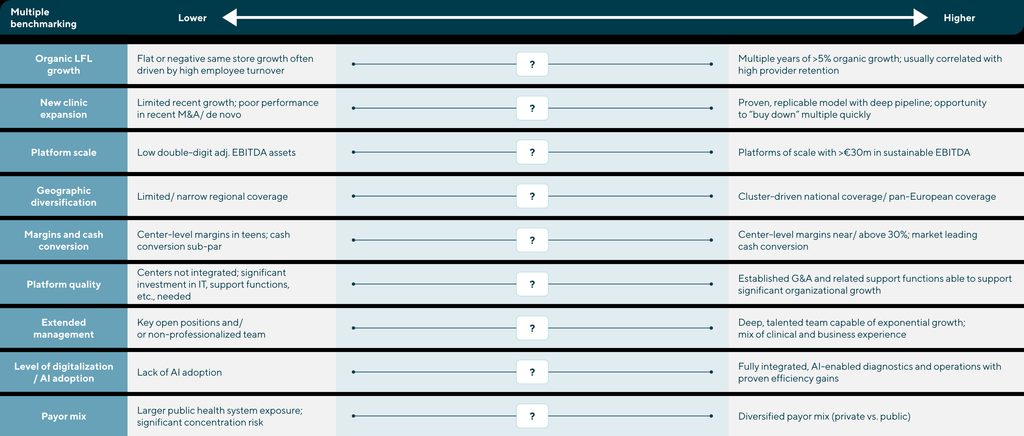
It’s a distinction that is becoming increasingly important for investors. The premium is not simply created by adding more EBITDA and more sites, it comes from the quality of the underlying assets, the strength of the management infrastructure, the ability to generate organic growth and the extent to which the platform can support further strategic expansion.
Technology: a platform differentiator
Technology is reinforcing that trend. The initial investment case for AI in diagnostic imaging was largely about productivity, and that remains important, but Roth argues that the opportunity is broader.
“We’re probably one or two steps beyond productivity gains alone,” he says. “AI and technology need to be deployed across the entire platform to improve overall medical quality.”
The question is no longer whether a provider has purchased an AI tool, it is whether technology is embedded deeply enough into the operating model to create a structural advantage.
Scale still matters. A larger platform can standardise systems across its clinics, create common data infrastructure and spread the cost of investment, while centralised management can drive consistent adoption across the network.
The technology opportunity extends beyond AI itself. Löffler points to teleradiology, automated equipment, data-driven analysis and utilisation management as part of a broader technology-enabled provider model.
“The tech piece is a very broad one with regard to ADI,” he said.
That also provides a useful distinction between technology as a point solution and technology as a platform capability. A standalone AI product may improve a particular part of the diagnostic process, but a provider that can integrate AI, workflow, data, equipment and clinical management across a network has the potential to create a more durable operating advantage.
The patient journey: the next frontier
The evolution of the market also goes beyond imaging itself. Roth points to the opportunity to build platforms around the patient’s journey rather than a single medical indication.
He highlighted orthopaedic care as an example: a patient may require imaging before treatment and rehabilitation afterwards. An integrated provider can potentially capture more of that pathway rather than treating imaging as an isolated service.
“We see ADI being implemented along the patient value chain,” Roth says.
This creates another potential source of growth. A platform that combines imaging with adjacent indications and services can diversify its revenue base while creating additional opportunities for organic growth and acquisitions.
It also provides strategic flexibility. If consolidation opportunities or valuations become less attractive in one indication or geography, an integrated platform may have other avenues for expansion.
Flexibility could become increasingly valuable as the next phase of European consolidation develops. Rather than relying on a single acquisition pipeline, investors can build businesses with multiple avenues for growth – within a country, across geographies, across imaging modalities or into adjacent parts of the patient journey.
Valuation becomes more demanding
The shift in the investment thesis is also affecting valuations.
Roth says investors have become increasingly focused on cash-flow-based valuation and less willing to accept the aggressive EBITDA adjustments that were possible during the previous wave of enthusiasm.
“Previously you were able to sell off an EBITDA that was heavily adjusted and perhaps even included a pipeline of unsigned future M&A deals and their potential synergies,” he says. “The days of such EBITDA adjustments have gone.”
Multiples have consequently fallen from the levels seen three or four years ago. Löffler estimates the broader market contraction at roughly two to three turns, while noting that a valuation gap remains between some owners’ expectations and what investors are currently prepared to pay.
That makes the eventual exit increasingly important. Investors are no longer able to rely simply on multiple expansion or acquisition arbitrage, they need confidence that the business can generate sustainable organic growth, cash flow and strategic value for the next buyer.
That puts greater emphasis on the characteristics that can support an eventual exit: scale, sustainable growth, strong cash conversion, professional management, technology infrastructure and strategic relevance to a larger healthcare or infrastructure investor.
Nevertheless, the strongest platforms can still command a premium, particularly where they demonstrate genuine integration, strong management infrastructure and deployment of AI and technology across the business.
The opportunity
For Lincoln, the opportunity lies in high-quality businesses from the middle of the market.
Löffler says the firm’s focus is currently on platforms generating roughly €30m to €60m of EBITDA, where there is sufficient scale to support a sophisticated operating model but still significant scope to shape the business strategically.
The opportunity is not necessarily to find the biggest business, but in finding a business with the greatest strategic optionality.
That could mean expanding within a country, entering new European markets, adding imaging capabilities, moving into adjacent indications or building a broader patient pathway.
The next phase of ADI investing is unlikely to be defined simply by the number of sites that can be acquired or the amount of EBITDA that can be added through M&A. It will be about whether an investor can build a platform that combines organic growth, acquisitions, technology and clinical capabilities in a way that creates value beyond simple consolidation.
Demographic change and rising diagnostic demand provide the foundation. Consolidation can create scale, but centralisation, technology, AI, clinical quality and expansion across the patient journey are what determine whether scale becomes a genuinely valuable platform.
The next winners in European diagnostic imaging may not be the businesses that simply own the most scanners or clinics. They will be the ones that can turn those assets into a more efficient, technology-enabled and clinically integrated healthcare platform – and demonstrate why the next investor should want to own it.